Leverage Virtual Assistants for E-commerce Customer Support

Did you know 87% of consumers consider customer experience a key factor when making online purchase decisions? In today’s competitive e-commerce landscape, exceptional customer support isn’t a luxury, it’s a necessity. Yet, as your business scales, the pressure on your in-house support team grows.
This is where virtual assistants (VAs) come in. Skilled professionals working remotely, VAs can act as an extension of your team, helping you improve customer experience, streamline operations, and grow your business, all without inflating overhead costs.
In this blog, we’ll explore how CEOs, CX leaders, marketing heads, and e-commerce operations teams can leverage VAs to transform customer support, unlock efficiencies, and achieve significant ROI.
Table of Contents
Tasks Handled by Virtual Assistants
Exceptional customer support is critical for e-commerce growth, but it comes with challenges. Scaling your in-house team can be expensive and slow, while relying solely on automated solutions may lack the personal touch that builds customer loyalty.
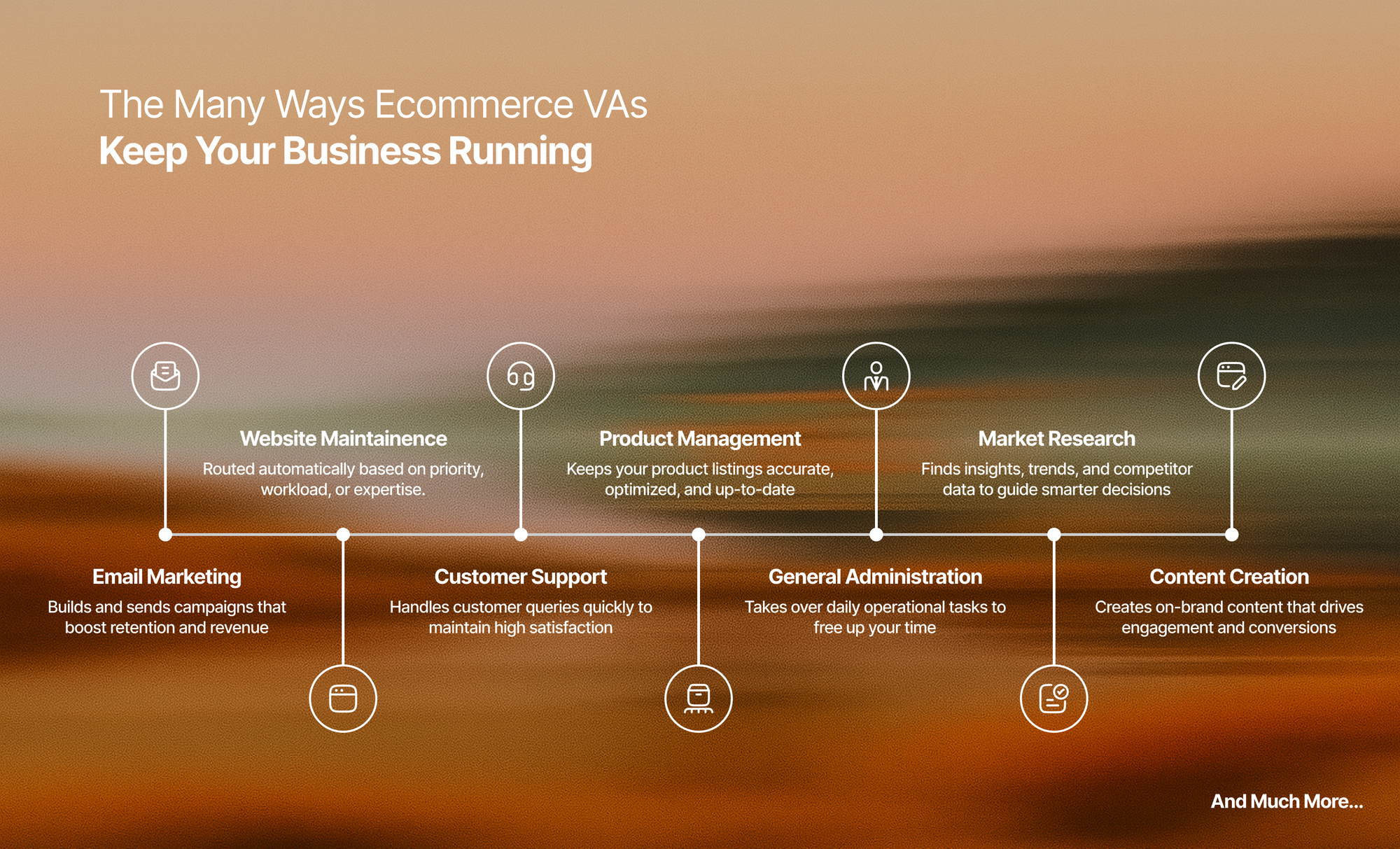
Virtual assistants offer a flexible and cost-effective solution. They can manage a wide range of tasks such as responding to customer inquiries, providing order updates, troubleshooting minor issues, supporting pre-sales engagement, and managing returns and exchanges. By handling these operational aspects, VAs free up your in-house team to focus on complex issues and strategic growth initiatives.
If you want to explore why Shopify stores specifically benefit from VAs, check out our detailed blog on why every Shopify store needs a virtual assistant in 2025.
Generalist vs Specialist Virtual Assistants
Not all VAs are created equal. Choosing the right type for your e-commerce business is critical to ensure efficiency and ROI.
| Feature | Generalist VA | Specialist VA |
|---|---|---|
| Skills | Broad: admin, email management, social media, customer inquiries | Deep: e-commerce platforms, product expertise, technical troubleshooting |
| Strengths | Adaptable, able to handle diverse tasks | Efficient at complex tasks, accurate solutions |
| Drawbacks | Limited expertise in specific areas | Less flexible outside their specialization |
| Best for | Routine inquiries, scheduling, data entry | Product research, compliance, technical support |
| Cost | Lower | Higher |
Choosing the right fit depends on your business needs, inquiry complexity, and budget. Many e-commerce brands use a combination of both types, leveraging generalists for everyday tasks and specialists for high-impact, complex work
What Else Could You Use Virtual Assistants For?
While VAs are great at handling routine tasks like inquiries and returns, their potential extends far beyond these basics. By strategically leveraging their skill set, you can unlock even greater benefits for your e-commerce customer support:
1) Proactive Customer Engagement
Virtual Assistant (VAs) can be trained to proactively engage customers based on browsing patterns or purchase history of your customers. For instance, if a customer is browsing a specific product, a VA can reach out via chat to answer questions, provide recommendations, or suggest complementary products to them. This approach shows customers that you care, increasing satisfaction and conversion rates while saving your teams time.
2) Social Media Monitoring and Engagement
In today’s world, social media plays a crucial role in customer interaction. Your VAs can monitor comments, messages, and mentions across platforms without you spending hours on it. Experienced VAs can also respond quickly and professionally, helping build trust, manage community engagement, and grow brand presence, at a fraction of the cost of hiring a full-time social media manager.
3) Content Creation and Knowledge Base Management
A VA can also support content creation and self-service resources. They can draft FAQs, blog posts, tutorials, or even short video guides that help customers find answers independently. This not only improves customer experience but reduces pressure on your support team. A well-maintained knowledge base also enhances brand credibility and encourages repeat purchases.
By expanding the role of VAs beyond traditional support, you can turn them into strategic partners who actively contribute to growth and operational efficiency.
Bonus VA Strategies for E-commerce Success
To get the most out of your VA team, consider integrating advanced strategies into your operations:
a) Leverage AI and Chatbots
Integrating VAs with AI-powered chatbots can create a seamless customer experience. Routine inquiries about orders, shipping, or returns can be handled instantly by the bot, while VAs focus on more complex issues that require human judgment. This combination improves response times, increases customer satisfaction, and maximizes efficiency.
b) Build a Multilingual VA Team
Serving customers in the US, UK, and Australia often means engaging with diverse audiences. Hiring VAs with multilingual capabilities allows you to provide localized support, building trust and loyalty across different regions.
c) VA Specialization and Training
Investing in training ensures your VAs represent your brand consistently. They should understand your products, brand tone, and customer service standards to provide confident, accurate, and professional interactions.
d) Performance Measurement and Feedback
Like any business function, VA performance should be monitored and optimized. Track metrics such as response time, resolution rate, and customer satisfaction. Collect feedback through surveys and reviews to continually refine your support strategy.
Final thoughts
Virtual assistants are no longer just cost-saving support staff, they are strategic partners for e-commerce growth. By leveraging their skills for routine tasks, proactive engagement, social media, and content creation, your brand can improve customer experience, reduce operational costs, and scale efficiently.
TL;DR
- Customer experience drives sales: 87% of consumers prioritize it in online purchases.
- Scaling in-house support is costly: Virtual assistants (VAs) provide a flexible, cost-effective alternative.
- Tasks VAs can handle: Customer inquiries, order updates, returns, pre-sales engagement, and troubleshooting.
- Types of VAs:Generalists: Broad skills, handle everyday tasks, lower cost.Specialists: Deep expertise, handle complex tasks, higher cost.
- Extended VA roles: Proactive engagement, social media monitoring, content creation, knowledge base management.
- Advanced strategies: Integrate AI/chatbots, build multilingual VA teams, invest in training, track performance.
- Outcome: VAs aren’t just support, they’re growth partners who improve customer experience, efficiency, and ROI.