



A customer just sent a furious message. Their order is late, they've emailed twice already, and now they're threatening to leave a one-star review. Your customer service agent has 30 seconds to respond. What happens next depends on whether they know their de-escalation techniques.
This is not a rare situation. For eCommerce brands, especially on Shopify, angry customers are part of the job. The question is not whether they'll show up. It's whether your team knows how to handle customer service escalation before it spirals.
In this blog, you'll get 7 practical de-escalation techniques that work in real customer service scenarios. Whether you're building a team or training your first agent, these techniques will help you reduce tension, resolve issues faster, and protect your brand reputation.
What Are De-Escalation Techniques in Customer Service?
De-escalation techniques are structured methods a customer service agent uses to reduce tension in a difficult interaction. The goal is to move a frustrated customer from anger to resolution, without things getting worse.
In customer service, de-escalation isn't about making the customer wrong or proving a point. It's about understanding what they need and finding a path to fix it. Done well, it transforms a near-churn customer into a loyal one.
Effective de-escalation in customer service involves a combination of active listening, empathetic language, clear communication, and knowing when to bring in extra help. It's a skill, and like all skills, it gets better with training and repetition.
The best customer service teams don't just react to angry customers. They have a process. They know what to say, what not to say, and how to stay calm when emotions are running high.
Why Customer Escalation Happens in the First Place
Before you can apply de-escalation techniques, it helps to understand why customers escalate in the first place.
Most customer escalation is not really about the product. It's about feelings. Customers escalate when they feel:
- Ignored or dismissed after a previous contact
- Like no one is taking ownership of their problem
- That they're repeating themselves with no progress
- Frustrated by a slow or confusing resolution process
For Shopify brands, the most common triggers are delayed shipments, wrong items, refund delays, and unhelpful auto-responses. Each of these is manageable, but only if your team catches the frustration early and knows how to de-escalate a situation with a customer before it blows up.
Understanding the root cause of a customer escalation changes how your agent responds. It shifts the interaction from "fixing a problem" to "helping a person."
7 De-Escalation Techniques That Actually Work
These are the de-escalation techniques that experienced customer service teams use every day. They're practical, trainable, and they get results.
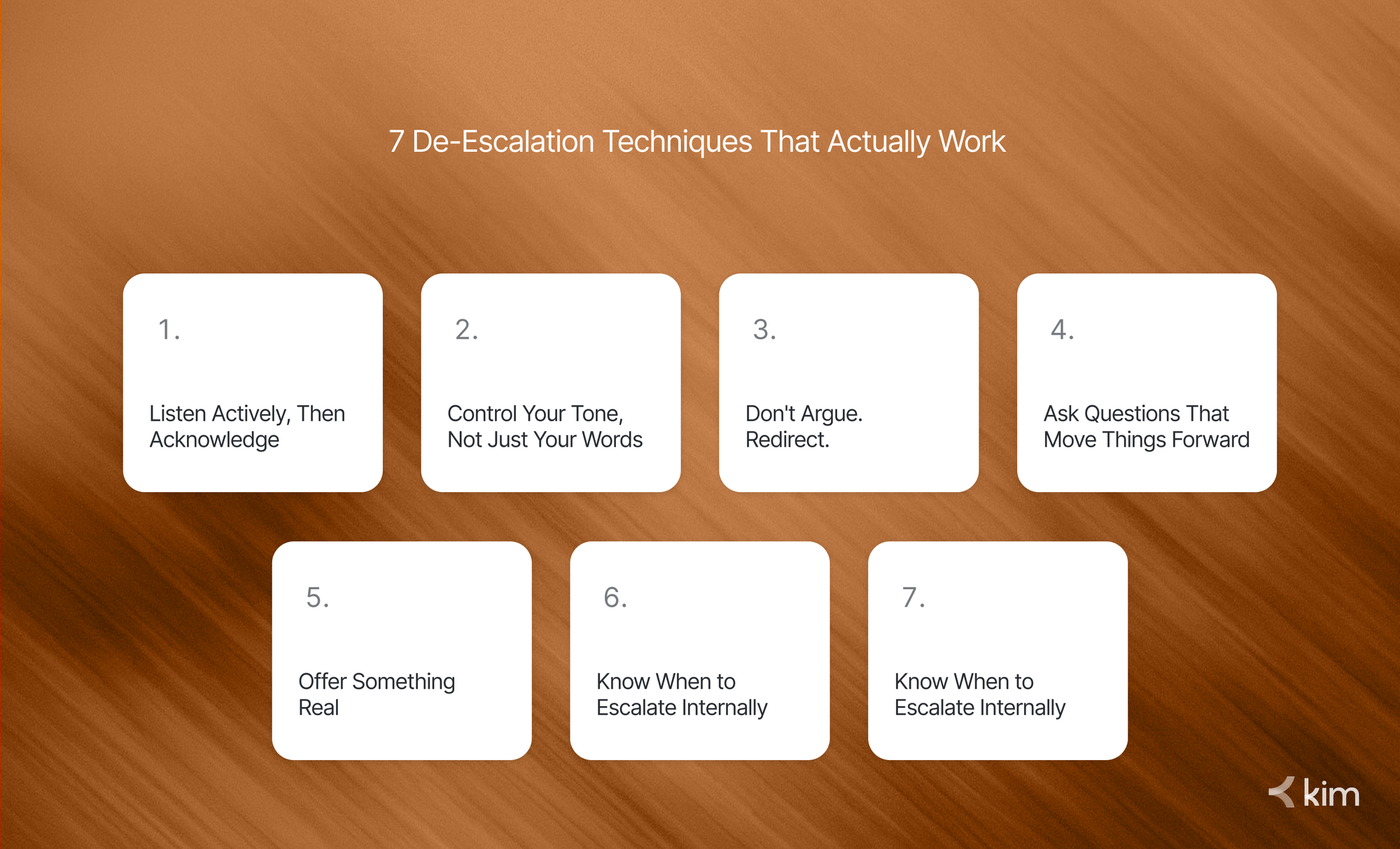
1. Listen Actively, Then Acknowledge
The first rule of de-escalation: let the customer finish. Do not interrupt. Do not jump to solutions.
Once they've vented, acknowledge what they said. Use phrases like:
- "I completely understand why you're frustrated."
- "That shouldn't have happened, and I'm sorry it did."
- "Thank you for bringing this to us. Let me sort this out for you."
This isn't about agreeing with the customer's version of events. It's about making them feel heard. Customers who feel heard are already calmer than customers who feel dismissed.
2. Control Your Tone, Not Just Your Words
Tone matters as much as the message, especially in live chat or phone support. A customer service agent who sounds defensive or robotic will escalate the situation, even with the right words.
In written support, keep sentences short. Use warm, human language. Avoid corporate jargon like "per your request" or "as per our policy." Say "I'll take care of this for you" instead.
In phone support, slow down. A calm, measured pace signals confidence and control. Match the customer's concern, not their frustration.
3. Don't Argue. Redirect.
When a customer says something factually wrong or unfair, the instinct is to correct them. Resist it.
Arguing never de-escalates. It just creates a second conflict on top of the first. Instead, redirect: "I hear you. Let me look into this right now and see what I can do."
You're not agreeing. You're moving the conversation forward. That's what matters.
4. Ask Questions That Move Things Forward
Good questions do two things: they gather information and they signal that you're engaged. Questions like:
- "Can you share your order number so I can pull this up immediately?"
- "What would the ideal resolution look like for you?"
- "Has anything like this happened before with us?"
These questions shift the customer's focus from venting to problem-solving. That shift is a key part of how to de-escalate a situation with a customer effectively.
Avoid closed questions that put them on the defensive. "Did you check the tracking link?" sounds accusatory. "I'm pulling up your tracking now. Do you mind if I walk you through it?" sounds helpful.
5. Offer Something Real, Not Just an Apology
Apologies are necessary but not sufficient. After you've acknowledged the issue, the customer needs to see action.
Give them a clear next step: "I'm processing your refund now. You'll see it in 3-5 business days." Or: "I'm escalating this to our logistics team and will update you by tomorrow at noon."
Specificity builds trust. Vague promises like "we'll look into it" leave customers feeling uncertain, and uncertain customers re-escalate.
6. Know When to Escalate Internally
This might sound counterintuitive, but knowing when to pass a customer to a senior agent is a core de-escalation technique.
Some situations exceed a frontline agent's authority or experience. Forcing an agent to handle something outside their scope creates delays, and delays create more frustration.
Have a clear escalation path internally. Define which situations go to a team lead, which go to a manager, and which need a policy exception. A customer escalation handled correctly by the right person is far better than a prolonged interaction handled poorly by the wrong one.
7. Follow Up After Resolution
Most teams close the ticket and move on. The best teams check back in.
A short follow-up message 24-48 hours after resolution can turn a bad experience into a memorable one. "Hi Sarah, just checking in to make sure your replacement arrived and everything looks good. Let us know if there's anything else."
This is a small gesture. But it signals that your brand cares beyond just closing the ticket, and that is a powerful differentiator for Shopify brands competing on customer experience.
How to Handle Customer Service Escalation in Real Time
Even with the best de-escalation techniques, some situations escalate fast. Here's how to handle customer service escalation when it's already in motion.
Step 1: Pause before responding. A rushed, defensive reply makes things worse. Take 30 seconds to understand what the customer actually needs.
Step 2: Validate first. Open with empathy, not policy. "I understand this has been a frustrating experience" lands better than "Our return policy states..."
Step 3: Take ownership. Say "I will handle this" not "Someone will get back to you." Ownership signals accountability. Accountability builds trust.
Step 4: Set a clear expectation. Tell the customer exactly what happens next and when. Then do it.
Step 5: Document the interaction. Log what happened, what was promised, and what the outcome was. This protects both the customer and your team, and feeds directly into your de-escalation training for customer service agents.
De-Escalation Training for Customer Service Teams
One of the biggest mistakes growing eCommerce brands make is assuming de-escalation is common sense. It's not. It's a skill that needs to be taught, practiced, and reinforced.
Effective de-escalation training for customer service should include:
- Role-playing real scenarios: Use your actual ticket history, especially the hardest ones
- Language frameworks: What to say, what to avoid, how to phrase difficult decisions
- Tone coaching: Especially for phone and live chat agents
- Escalation playbooks: Clear criteria for when to escalate internally and to whom
- Regular review sessions: Reviewing real interactions as a team and discussing what worked
Training should not be a one-time onboarding activity. The best teams revisit it quarterly and update it as new customer scenarios emerge.
New agents especially need structured de-escalation training. Without it, they default to either over-apologising (which can be exploited) or becoming defensive (which escalates things further). Neither serves your brand.
Tools and Support Systems That Help Teams De-Escalate Faster
De-escalation doesn't happen in a vacuum. The tools your customer service team uses directly affect their ability to stay calm, respond quickly, and resolve issues effectively.
A few things that genuinely help:
A unified helpdesk: Agents need full context before they respond. Switching between tabs to find order info creates delays and missed details. Tools like Gorgias, Zendesk, and Freshdesk give agents a single view of the customer.
AI-assisted responses: Smart suggestions and pre-approved language templates help agents respond with the right tone without having to think from scratch every time.
Human oversight on high-stakes interactions: AI is useful, but complex customer escalation scenarios still need a human in the loop. Platforms like kim.cc combine AI efficiency with trained human agents specifically for eCommerce brands, so your team has both speed and judgment when it counts most.
Clear escalation workflows: Whatever tool you use, make sure the path from frontline to manager is fast, documented, and reliable.
FAQ
What are de-escalation techniques in customer service? De-escalation techniques are communication strategies a customer service agent uses to calm an upset customer and move toward a resolution. They include active listening, empathetic language, tone control, redirection, and clear action steps.
How do you de-escalate a situation with a customer? To de-escalate a situation with a customer, start by listening fully without interrupting. Acknowledge their frustration, take ownership, and offer a specific resolution with a clear timeline. Avoid arguing or citing policy as a first response.
What causes customer escalation in eCommerce? Customer escalation in eCommerce is most often triggered by delayed shipments, poor communication, unresolved previous contacts, and slow refunds. The common thread is a feeling that the brand does not care.
Why is de-escalation training for customer service important? De-escalation training gives customer service agents the skills, language, and confidence to handle difficult interactions without making things worse. Without training, agents default to patterns that often increase tension rather than reduce it.
When should a customer service agent escalate internally? A customer service agent should escalate internally when the situation involves a policy exception, a significant financial resolution, a legal complaint, or any scenario beyond their trained authority level.
How long does it take to de-escalate an angry customer? With the right de-escalation techniques, most customer escalations can be turned around in a single interaction, often within 5-10 minutes. Complex situations may take longer, especially if they require coordination with logistics or finance teams.
Conclusion
De-escalation techniques are not just a nice-to-have for eCommerce brands. They are a core operational skill that directly affects customer retention, review scores, and long-term revenue.
When your customer service team knows how to de-escalate a situation with a customer, they turn negative experiences into proof points of your brand's reliability. When they don't, a single bad interaction can undo months of marketing effort.
The 7 de-escalation techniques in this article: active listening, tone control, redirection, smart questioning, real action steps, internal escalation, and follow-up, are practical and trainable. Start with your hardest recent customer escalation. Walk your team through it using these frameworks. Then make de-escalation training for customer service a recurring part of how you develop your team.
How many customers are you losing because one difficult conversation was handled poorly?
A single unresolved escalation can lead to negative reviews, lost revenue, and customers who never come back. Make sure every interaction strengthens trust instead of damaging it.


